Life History of the Common Jay

Life History of the Common Jay (Graphium doson evemonides)


Butterfly Biodata:
Genus: Graphium Scopoli, 1777
Species: doson
C & R Felder, 1864
Subspecies: evemonides
Honrath, 1884
Wingspan of Adult Butterfly: 50-65mm
Local Caterpillar Host Plants:
Desmos chinensis (Annonaceae, common name: Dwarf Ylang Ylang), Michelia alba (Magnoliaceae, common name: White Champaca), Polyathia longifolia var. pendula (Annonaceae, common name: False Ashoka Tree).


A Common Jay found on damp ground.


A Common Jay perching on a leaf.

Physical Description of Adult Butterfly:
As with most Graphium species, the wings are produced at the forewing apex and hindwing tornus, and the inner margin of the hindwing bends inwards. Above, the wings are black with a broad bluish-green macular band running from the sub-apical area of the forewing to the basal area of the hindwing. There is also a series of bluish-green streaks in the cell of the forewing. A series of bluish-green submarginal spots is present in both fore- and hindwings. Underneath, the same spotting pattern can be found against a dark brown base, with the spots larger and more silvery green. Additional red and black spots are featured on the hindwing. There is a dark red-centred costal bar sited right in the silvery middle cross band of the hindwing. In Singapore, the presence of this costal bar is the main distinguishing feature between Common Jay and the more commonly found Blue Jay.


A puddling Common Jay.


A Common Jay perching on a leaf in a hill park.

Field Observations of Butterfly Behaviour:
Although the Common Jay is common in neighbouring Malaysia, it has only been recently discovered in Singapore on the offshore island of Pulau Ubin in 2005. It is not listed in the original butterfly checklist for Singapore, and is believed to have migrated from nearby Johor in Malaysia and established its presence in P. Ubin where one of its host plants is available in relative abundance. There has only been one isolated sighting of an individual in mainland Singapore in late 2006. The swift-flying adults haven been sighted visiting flowers, and making ovipositing visits to the host plants. The males of this species can be found puddling along damp foot paths.


A Common Jay perching on a grass blade in an open field.


A male Common Jay.

Early Stages:
With its wide distribution and common occurrence in the region outside Singapore, early stages of the Common Jay have been documented earlier, and its many host plants already identified by researchers and enthusiasts working in these areas. In Singapore, the early stages of the Common Jay feed on young leaves of several plants in the Annonaceae and Magnoliaceae families. One host, Desmos chinensis, grows in relative abundance in P. Ubin and seems to be the host of choice for the Common Jay in that habitat. Eggs and early stages of the Common Jay are typically found on young leaves of this host at low heights.


Local host plant #1, Desmos chinensis (Dwarf Ylang Ylang).


Local host plant #2 : Polyathia longifolia var. pendula (False Ashoka Tree).


A mother Common Jay laying an egg on a young leaf of Desmos chinensis in Pulau Ubin.

The eggs of the Common Jay are laid on young leaves of the host plant on either the upper- or undersides. The spherical egg is initially creamy white with a diameter of about 1.0-1.1mm. As it matures, it gradually turns yellow.


Two views of an egg of the Common Jay.


Two views of a mature egg of the Common Jay. Note the outline of the head capsule and the mandibles which are now visible through the egg shell.


Three views of a newly hatched Common Jay nibbling away at the egg shell. Note the darkening of body color from 1st to 2nd pic.

The egg takes 3-4 days to hatch, and the newly hatched has a body length of about 2.2mm. The entire egg shell is consumed by the newly hatched as its first meal. The body is initially pale yellowish but turning dark brown gradually and this happens even as the egg shell is being consumed. The last abdominal segment is white in color in contrast. A pair of brown lateral spines can be found on each of the three thoracic segments, and another white pair at the anal segment. The body also features rows of short dorsal-lateral tubercles with long setae. The head capsule is yellowish brown.


Two views of a newly hatched Common Jay caterpillar.


Two views of a 1st instar caterpillar, , length: 3.5mm

Between feeds, the Common Jay caterpillar of all instars rests on the upper leaf surface, usually alongside the midrib. After about 3-3.5 days of feeding, the 1st instar caterpillar grows to a length of about 5.5-6mm. The moult to the 2nd instar takes place after a period of inactivity.


A first instar caterpillar found resting on the upperside midrib of a young leaf of Desmos chinensis in the field.

In the 2nd instar, the thoracic segments are much enlarged from the 2nd to 3rd segment. The thoracic and anal pairs of spines are rather drastically reduced in size in proportion to the body. Between them, the prothoracic pair is longer compared to the other two. The head capsule is still yellowish brown but has an increase in orange tone. The body remains dark brown throughout this instar and t
he sub-spiracular area of the abdominal segments are whitish. This instar lasts for 1.5-2 days, and has the body length increased up to about 8mm.


Two views of a 2nd instar caterpillar, late in this stage, length: 7.2mm


Field shots of a 2nd instar Common Jay caterpillar on the same leaf over the course of 2 hours.
Left: resting on the midrib near its 1st feeding site; Right: feeding at a 2nd site.


The 3rd instar caterpillar resembles the 2nd instar caterpillar closely. The head capsule is orangy brown at this stage. In about 3 days, the caterpillar grows to about 15mm in length before the moult to the 4th instar takes place.


Two views of a 3rd instar caterpillar, length: 12mm.

The body of the 4th instar caterpillar is initially dark brown soon after moulting but turning much paler yellowish brown for most part of this instar. The caterpillar has a pale orangy brown head capsule, and the base of the metathoracic pair of splines is vaguely encircled in ring of yellow or pale brown. The dark thoracic pairs of spines also take on a bluish sheen when viewed at certain perspectives. Now the sub-spiracular area of all body segments are whitish to varying extent. This instar lasts about 3-4 days with the body length reaching about 24mm.


Two views of a newly moulted 4th instar caterpillar, eating its exuvia, length: 15mm.


Two views of a 4th instar caterpillar, length: 23mm.


A Common Jay caterpillar moulting to its final (5th) instar.

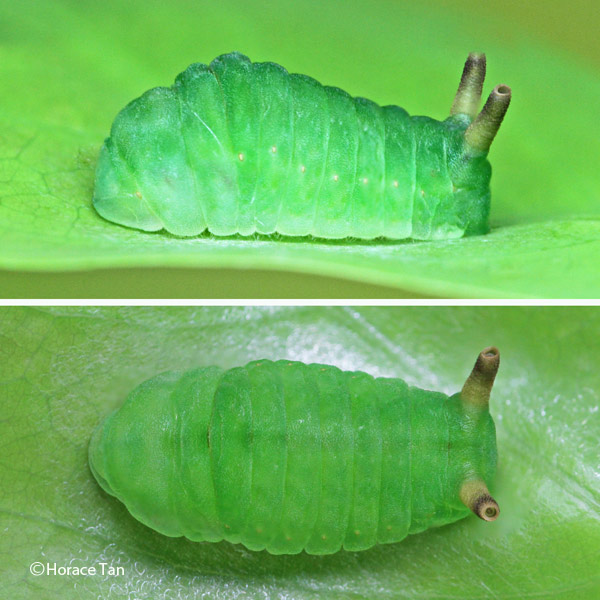
The 5th instar caterpillar resembles the late 4th instar caterpillar, but with the metathoracic pair of splines larger and more prominently marked with a black-outlined yellow to yellowish brown ring at the base, and the mesothoracic pair minuscule or even absent. The last abdominal segment is no longer white but follows the same coloration as the other segments. Each of the two anal splines is still whitish but takes on a black stripe on its outer edge. Soon after moulting, the body color is yellowish brown. In some individuals, the body soon changes to a green to dull green coloration, whilst others remain yellowish brown until in the last day of this instar before the color change takes place. The 5th instar lasts for 4-5 days, and the body length reaches 39-44mm.


Two views of a 5th instar caterpillar, early in this stage, length: 24mm.


Two views of a 5th instar caterpillar, yellowish brown form, length: 28mm.


Two views of a 5th instar caterpillar, green form, length: 35mm.

Toward the end of the 5th instar, the body gradually shortens in length and turns completely pale greenish. The caterpillar wanders around for a pupation site and eventually comes to rest on one spot of a leaf in an upright position. Here the caterpillar prepares and secures itself with a a silk pad and a silk girdle.


A 5th instar Common Jay caterpillar found in the field.


Two views of a pre-pupatory larva of the Common Jay.

Pupation takes place a day later. The pupa is pale yellowish green, about 27-30mm in length and has a slender and obtusely pointed mesothoracic horn. There are two short and blant cephalic horns. The abdomen has two dorsal carinae which are whitish to pale yellowish and run laterally and continuously to the tip of the mesothoracic horn.


The pupation event of a Common Jay caterpillar.


Two views of a pupa of the Common Jay.

The pupal period lasts for 9 days, and the pupa turns black in the wing pads the night before eclosion. The bluish-green spots on the forewings are visible through the pupal skin at this stage. The adult butterfly emerges the next morning to commence the adult phase of its life cycle.


Two views of a mature Common Jay pupa.


The eclosion event of a Common Jay butterfly.


A newly eclosed Common Jay clinging on to its pupal case.

References:

  • [C&P4] The Butterflies of The Malay Peninsula, A.S. Corbet and H.M. Pendlebury, 4th Edition, Malayan Nature Society.
  • Butterflies of Thailand, Pisuth Ek-Amnuay, 1st Edition, 2006
Text by Horace Tan, Photos by Sunny Chir, Khew SK and Horace Tan

Special thanks to Prof Hugh Tan, Department of Biological Sciences, NUS, and a NParks staff at Ubin for their kind assistance in providing ID for the host plant, Desmos chinensis.

Butterfly Portraits
Five Bar Swordtail (Pathysa antiphates itamputi)


Nikon D50, fill-flashed with Sigma EM-140 DG Macro Flash, Tamron 180mm f/3.5, ISO 200 ; 1/400s ; f/5 ; Aperture Priority Mode and Rear Sync ; Handheld.

Back in 2009, I had just gotten my hands on the “standard issue” Tamron 180mm f/3.5 Macro lens, which is the macro lens of choice of most of ButterflyCircle's members. I was eager to put my new toy through its paces and couldn't wait to go out to shoot butterflies. I recall that it was a sunny April Saturday, where the butterfly season was nearing its peak, when I went to one of our favourite puddling grounds.

After about an hour of waiting, a Five Bar Swordtail (Pathysa antiphates itamputi) swooped down from the tree tops to puddle. This individual was particularly alert, taking off with the slightest disturbance. After having its fill of puddling, it flew off to some bushes to rest. It was hard to get close as the bushes were in the way and any slight movement would spook the skittish butterfly off

After a few attempts, the "butterfly fairy" finally smiled upon me. The Five Bar Swordtail landed on the edge of a clump of ferns. This allowed me to move in slowly and carefully with “tai chi” movements. As I got into position, raised my camera and looked into the view finder, I was delighted to see that the grassy slope in the background gave a smooth green background. I pressed and held the shutter, hoping to get as many shots of it as possible, but it took off after the second shot was taken.

This is one of my favourite shots till today. Firstly, getting a shot of this butterfly is already quite challenging but managing to nail a sharp shot of a pristine individual with a clean green background made it a shot that I am extremely proud of.

ButterflyCircle Photographer : Anthony Wong, an undergraduate in his mid-20's.

Singapore-Hong Kong Butterfly Hospitality

Singapore-Hong Kong Butterfly Hospitality!
Visit by the Hong Kong Lepidopterists Society


It all began with an email from James Young, the 2010 Chairman of the Hong Kong Lepidopterists Society to ButterflyCircle member Horace Tan, to request for some assistance on information of good butterfly watching locations in Singapore. A small group of the HKLS members, led by Arex Li, and which also included the former Chairman of HKLS, Dr Lee Ping Chung would be visiting Singapore for a butterfly watching/photography tour.


Unfortunately, the HKLS trip dates clashed with another trip that some of the senior BC members were making to Perak, Malaysia. Other senior members were also away, either for work assignments or for holidays. The organisation and assistance to the HKLS entourage was therefore left to BC member Anthony Wong. This is Anthony's story about the HKLS visit :


"After a few emails between Arex Li and me, about which locations are good for butterfly watching in Singapore, I learnt that the bunch of 6 veteran butterfly watchers from HKLS had planned fulfil their goal of spotting species of Hairstreaks (Lycaenidae) and Skippers (Hesperiidae) in Singapore.

HKLS members working as a team with supplementary flash lighting to improve a shot

The locations of the itinerary had to be changed to places which were less accessible, a tougher terrain to walk, and lunch had to be taken out of the picture! These guys and gals are certainly hardcore with an insatiable appetite for butterfly watching.

A Ciliate Blue sunbathing during the outing with our HKLS friends

Day 1
After picking them up from their hotel, we zoomed to Dairy Farm Nature Park to rendezvous with ButterflyCircle members Ben Yam and Yao Yang. The gloomy weather did not dampen the HKLS visitors one bit and I can recall Arex jokingly saying that the dark clouds are just an illusion, and after saying so, the intrepid bunch decided to brave the weather and pressed onwards into the trails.


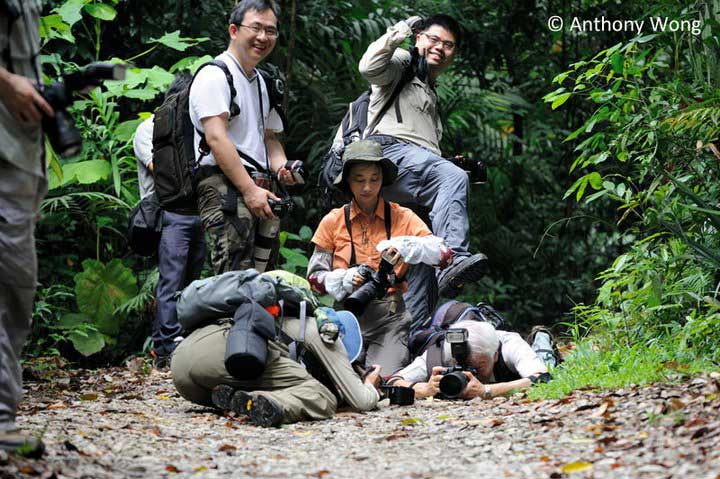
Dr Lee proning to get the butterfly's eye-level shot

A short drizzle, followed by strong sunshine and suddenly butterfly activity was at an all-time high for the day. A pristine Yamfly (Loxura atymnus fuconius) popped by to play. Everyone had lots of fun chasing this skittish butterfly and this certainly boosted the morale of the party. There was one point of time where the Yamfly stood still and long enough for “creative” lighting to be applied!


A cooperative Yamfly came out to play and posed for our HKLS visitors!

After a good day out in the field, everyone headed back hungry and tired. Dinner arrangements were covered by Mark Wong and we brought the group to Lao Pasat (Old Market) to savour the local delicacies such as BBQ stingray, Satay (Skewered Meat), Oh Luak (Oyster Omelette), just to name a few.


Are they going to finish ALL that food on the table??

Day 2
As the group got ready and planned to head out early in the morning, the weather on this Sunday was exceptionally wet for Singapore and probably one of the wettest day in the month. There were flash floods in certain parts of Singapore and our famous Orchard Road got flooded again! As it was raining cats and dogs, we had no choice but to hole up in the hotel and wait for the storm to pass.


Our bored Hong Kong visitors playing card games at the hotel, thanks to the heavy Sunday morning thunderstorms


One for the album - posing with BC's Field Guide to the Butterflies of Singapore!

That happened around noon time and Dr Lee did not want to waste another second and we headed to the Butterfly Lodge at Oh’ Farms for a round of shooting whilst waiting for the sun to shine.


HKLS and BC members at Oh' Farms. Left - Right : Anthony, Chung Pheng, Kwai Yin, Rachel, Dr Lee, Yeok Keong, Arex, Manson, Gigi and Benjamin (front)

A glimmer of hope came with the sky starting to brighten up. After a quick discussion with ButterflyCircle members Chung Peng and Ben Yam, we decided to head to a nearby reservoir nature reserve.


HKLS and BC members at Upper Seletar Reservoir Park

Our Hong Kong friends were rewarded with a number of Hairstreaks that came out in the afternoon after the heavy downpour. There was even a hungry one that kept on puddling on us. The catch of the day was the Pale Mottle (Logania marmorata damis). The leader and former Chairman of the HKLS group Dr Lee explained to me that this species is not found in Hong Kong and this is a new species to almost everyone in the group.

Arex Li demonstrating the latest Kung Fu Panda 2.0 pose for butterfly shooting

The group was very enthusiastic and made up for the wasted morning due to the rain, and continued to shoot till past 7pm! We ended the day with a scrumptious meal at the famous Rangoon Road Bak Kut Teh (Pork Ribs Soup).

Day 3
Although it was still drizzling, the enthusiastic group headed to Singapore Botanic Gardens to check out some favourite butterfly hangouts.


I recommended that we should head to the Ginger Garden, as there were always quite a number of skippers flying around that area, and true enough, a Common Snow Flat (Tagiades japetus atticus) was seen fluttering around. The rain and cool weather made the butterfly rather docile, and everyone probably got a good shot of this butterfly.


HKLS members posing with Horace Tan at MacRitchie Nature Trail

ButterflyCircle member Horace Tan met up with the group for lunch and we decided to head to MacRitchie Reservoir to check out certain spots to look for the Flos sp as the weather is improving.

Horace showing our HKLS friends the host plant of Flos apidanus

At the boardwalk trails at MacRitchie, we were greeted by several Branded Imperial (Eooxylides tharis distanti) and Common Posy (Drupadia ravindra moorei) fluttering around the forest fringes, allowing most of our visitors to get close enough to photograph the these pretty long tailed Hairstreaks.


The past few days of wet weather made the paths damp and slippery, but we could see quite a number of puddling butterflies, which were obviously hungry due to previous days of rain. The HKLS members certainly took their hobby very seriously, even equipping themselves with elbow and knee guards so they can prone on any hostile terrain to get the perfect shot!


Since this was their last night in Singapore, we decided to celebrate and Mark and I brought them to the famous fish-head curry restaurant at Samy’s Curry @ Dempsey Road. ButterflyCircle’s founding member Khew SK joined us for dinner despite having just returned after a long bus ride from a butterfly expedition over the weekend.


Our HKLS visitors having a spicy but sumptuous curry dinner at Samy's Curry @ Dempsey Road

The evening was spent sharing stories about the butterflies as the HKLS members showed us videos of butterflies feeding and frolicking in Hong Kong and other parts of the world where they had visited.


It was an exhausting but exciting 3 days spent with the lively and friendly members of HKLS. I have learnt many things such as how to apply back lighting for butterfly photography, how to take videos of butterflies, as well as the different behaviours and habitats of butterflies from around the world.

We hope that our Singapore hospitality helped to make the trip by our HKLS friends more fruitful and enjoyable, although the weather could have been more cooperative!


Text by Anthony Wong ; Photos by Gigi Lai, Arex Li, Anthony Wong, Mark Wong and Benjamin Yam

Special thanks to ButterflyCircle members, Benjamin Yam, Chung Pheng, Horace Tan, Mark Wong and Yao Yang for all the help rendered over the 3 days showing the HKLS members around Singapore's butterfly-hunting grounds. Thanks also to Yeok Keong of Oh' Farms for showing the HK group around the Butterfly Lodge as well as giving everyone a lift to Upper Seletar Reservoir Park.


Further Reading & References :

Life History of the Malayan Sunbeam

Life History of the Malayan Sunbeam (Curetis santana malayica)


Butterfly Biodata:
Genus: Curetis
Hübner, 1819
Species: santana Moore, 1858
Subspecies: malayica C & R Felder, 1865
Wingspan of Adult Butterfly: 40mm
Caterpillar Local Host Plants:
Callerya atropurpurea (
synonym: Millettia atropurpurea; Leguminosae), Millettia pinnata (synonym: Pongamia pinnata; Leguminosae).


A puddling Malayan Sunbeam found in the nature reserve.


A male Malayan Sunbeam sunbathing with its wings opened.

Physical Description of Adult Butterfly:
Above, the wings are bright orange with black borders. In the male, the black distal border continues to the dorsum in the forewing, and the third of the hindwing near the tornus is darkened. The female is in paler orange than the male and has much broader black borders. On the hindiwng the orange portion in the female only occupies a small crescentic area. Underneath, the wings are silvery white with obscure fasciae. On the forewing, the post-discal band runs from the costa near the apex towards the dorsum in an oblique manner. The post-discal striae are shaded inwardly with grey patches. Legs are banded in reddish orange.


Malayan Sunbeam: male (left); female (right). Note the minor difference in wing shape.


Another sunbathing male Malayan Sunbeam.


A male Malayan Sunbeam adult 'licking' a newly laid cement surface in a man-made jungle shelter.

Field Observations of Butterfly Behaviour:
This species is uncommon in Singapore. Individuals are typically encountered in the Central Catchment Area, Bukit Timah nature reserve, Southern Ridges, Singapore Botanical Gardens and on Sentosa Island. Adults can be occasionally sighted in these areas where they have been observed to engage in sunbathing, puddling, and ovipositing activities.


A sunbathing male Malayan Sunbeam giving us a glimpse of its upperside.


Another puddling Malayan Sunbeam.

Early Stages:
The two currently known local host plants, Callerya atropurpurea and Pongamia pinnata, belong to the Leguminosae family. The first of the two is a newly recorded host while the second is previously recorded by Col. C.T. Bingham in early 1900s in Mergui (C&P4). In Singapore, both plants can be found growing in the wild as well as being cultivated as wayside trees. The caterpillars of the Malayan Sunbeam feed on the young foliage of these host plants.


Local host plant : Callerya atropurpurea. Young leaves.


Local host plant : Callerya atropurpurea. Mature leaves.

Eggs are laid singly on young shoots of the host plant. At times several eggs can be found on one single young shoot. Each egg resembles a flattened bun with coarse hexagonal reticulations. It is initially pale greenish when newly laid but turns whitish as it matures. Each egg has a basal diameter of about 1mm.


Two views of an egg of the Malayan Sunbeam, diameter: 1mm.

It takes about 2.5 days for the egg to hatch. The young caterpillar consumes the upper portion of the egg shell to emerge. The remaining egg shell is left alone as the newly hatched proceeds to check out the immediate surrounding and nibble on leaf lamina for its first meal. With a length of 1.5mm, it has numerous fine setae on its body surface, with those occurring dorso-laterally and laterally particularly long.


Two views of a newly hatched caterpillar after a few nibbles, length: 1.8mm.

The caterpillar is initially yellowish green but turns dark yellowish or reddish brown as it develops in this instar. The first instar lasts about 2-2.5 days and its body length reaching about 3mm.


Two late 1st instar caterpillars lying dormant prior to their moult, length: 3mm.


Two views of a 1st instar caterpillar, dormant prior to its moult, length: 3mm.

The body of the 2nd instar caterpillar is covered with many short setae. Its body colour is dark yellowish to reddish brown, with variations existing between individual specimens. On each body segment, there are several oblique pale stripes laterally. A prominent change occurs on the 8th abdominal segment where a pair of long cylindrical and erect processes, black to dark brown in colour, is now present. When the caterpillar is disturbed or stressed, tentacles with tuffs of white and black hairs at their apices, are everted from these procesess and whirled around at great speed. This instar lasts for about 1.5-2 days and reaches a length of about 6.0mm.


Two views of a 2nd instar caterpillar, early in this stage, length: 3mm.


Two views of a 2nd instar caterpillar, later in this stage, length: 5.5mm

The 3rd instar caterpillar looks similar to the 2nd instar caterpillar but has a pair of white, quadrate lateral patches on the 5th abdominal segment.
White lateral stripes, varying in lengths but lesser in prominence than that on the 5th abdominal segment, appear later and becoming more prominent on the body segments. The body color varies from red to reddish brown, yellowish brown and greenish brown in different individuals. The caterpillar grows up to 11mm in this instar which lasts about 2-3.0 days.


Two views of a 3rd instar caterpillar, newly moulted, length: 5mm. Note the exuvia and head capsule lying nearby.


Two views of a 'red-form' 3rd instar caterpillar, early in this stage, length: 6mm.


Two views of another 3rd instar caterpillar with lesser degree of red skin tone, length:8.5mm

The 4th (and final) instar caterpillar resembles the 3rd instar caterpillar but with a more prominent contrast of white stripes/patches against the base colour of yellowish green to purplish/pinkish green. The dorsum of the body segments of the 2nd and 3rd thoracic segments are pale green/pink to whitish in coloration. The dorso-lateral oblique white stripes on the 1st two abdominal segments are joined or nearly joined while those on other segments are well separated.


Two views of a 'green-form', 4th instar caterpillar, earlier on in this stage, length: 13.5mm


Two views of a 'red-form' 4th instar caterpillar, length: 20mm.

The 4th (and final) instar lasts about 4 days and the body reaches up to a length of about 20mm. In the last day of this stage, the caterpillar ceases feeding, and its body shrinks in length. The entire body decolorises to a dark shade of jade green.


Two views of a 'red-form' 4th instar caterpillar, later in this stage, with reddish patches decolorised, length: 20mm.


A Malayan Sunbeam caterpillar reacts with the eversion of its tentacular organ when an intruding caterpillar gets too close for comfort.

Eventually, the late 4th instar caterpillar comes to rest on a spot on the surface (typically the upperside) of leaf. Here the caterpillar prepares for pupation by spinning a silk pad and a silk girdle to secure itself. It then becomes immobile in this pre-pupatory state for about 1 day.


Two views of a pre-pupa of the Malayan Sunbeam

The next day the pupation takes place. The pupa is held via its cremaster and a silk girdle to the silk pad on the substrate. It is almost hemispherical in shape and has a flat under surface. It is entirely jade green but with a fair number of white speckles dotting the pupal surface. There is a rather large spade-shaped whitish marking on the dorsum. In some specimens, this white marking is adorned with several yellowish brown dots. Length: 10-13mm.


The pupation event of a Malayan Sunbeam caterpillar.


Two views of a pupa of the Malayan Sunbeam.


Front view (left) and rear view (right) of a pupa of the Malayan Sunbeam.


Seven days later, the pupa becomes darkened in color signaling the imminent emergence of the adult. The orange patch on the forewing upperside can now be seen through the pupal skin in the wing case. The next day the adult butterfly emerges from the mature pupa.


Two views of a mature pupa of the Malayan Sunbeam.


A newly eclosed Malayan Sunbeam.

References:

  • [C&P4] The Butterflies of The Malay Peninsula, A.S. Corbet and H.M. Pendlebury, 4th Edition, Malayan Nature Society.
  • Butterflies of Thailand, Pisuth Ek-Amnuay, 1st Edition, 2006
Text by Horace Tan, Photos by Henry Koh, Loke PF, Sunny Chir and Horace Tan