Random Gallery - Yellow Flash

Random Butterfly Gallery
The Yellow Flash (Rapala domitia domitia)


The genus Rapala comprises of several small, stout-bodied and powerful flyers. These big-eyed species can zip around at tremendous speeds, earning them their English common name of "Flash". Of the many "Flashes" found in Singapore, the Yellow Flash (Rapala domitia domitia) stands out in that the undersides of the butterfly are a distinctive bright yellow with jet-black markings. The largest member of the genus in Singapore, the Yellow Flash is considered rare but can be observed with regularity at certain locations within the nature reserves.

This Yellow Flash was shot a couple of weeks ago by ButterflyCircle member Nelson Ong, who has been patiently tracking this species for a long time.  Having spotted the species many times, this was a satisfying success for Nelson, who finally managed to nail a well-composed shot of this skittish Lycaenid after a long period of hunting this elusive beauty.

Life History of the Darky Plushblue

Life History of the Darky Plushblue (Flos anniella anniella)


Butterfly Biodata:
Genus: Flos Doherty, 1889
Species: anniella Hewitson, 1862
Subspecies:  anniella Hewitson, 1862

Wingspan of Adult Butterfly: 34-38mm
Caterpillar Local Host Plants:
Lithocarpus elegans (Fagaceae, common name: Spike Oak), Lithocarpus conocarpus (Fagaceae), Lithocarpus ewyckii (Fagaceae).


A female Darky Plushblue sunbathing on a leaf.

Physical Description of Adult Butterfly:
Above, the male is shining violet blue with a very thin dark border; the female is pale purplish blue with broad brown to dark brown borders. Below, the markings are pale purplish brown with whitish outlines and overlaid with whitish scales in some of them. Compared to the other local Flos spp., these markings  do not contrast strongly with the  brownish ground colour. The hindwing has  a black tornal spot and a black marginal spot in space 2, both of which are surrounded  by brassy scales. Unlike the other local Flos spp., the hindwing of the Darky Plushblue is not tailed. Instead the end of vein 2 on the hindwing has a short tooth.


A male Darky Plushblue giving us a glimpse of its shining blue upperside.


Field Observations of Butterfly Behaviour:
The Darky Plushblue is moderately rare in Singapore and sightings of adults have been restricted to several shady forested locations or in the vicinity of its host plants within the central catchment reserve. The adults are strong flyers and they typically perch with their wings closed, but in sunny weather the females have been observed to open their wings fully to sunbathe in between ovipositing runs. In rare occasions, individual adults have been  seen visiting flowers and ripened fruits of the Singapore Rhodendron.


Early Stages:
The Darky Plushblue (as well as Flos fulgida and Flos diardi) was found in Singapore to be utilizing  Lithocarpus ewyckii as its larval host  about a half century ago by Morrell (Morrell, 1956). Recent field studies have added  Lithocarpus elegans and Lithocarpus conocarpus to the list of  larval host plants.  As in the case of all Flos spp. observed, caterpillars of the Darky Plushblue feed on young and immature leaves of the host plant, and have the habit of building shelters on a leaf for security and concealment. The caterpillars are often found to be in the company of ants on the resident leaves and in their shelters.

Leaf shelters used by Darky Plushblue caterpllars on Lithocarpus conocarpus (right); and  Lithocarpus elegans  (left).

Host plant #1: Lithocarpus elegans.

Host plant #2: Lithocarpus conocarpus.

Two mother Darky Plushbue laying eggs on  two different Lithocarpus spp..

Eggs are laid singly or in small groups of 2-3 on the petiole, stem or a leaf underside of a branchlet of the host plant. Each egg is about 0.8-0.9mm in diameter, white with a slight pale  green tinge. It is shaped like a pressed bun with a slightly depressed micropylar area atop. The surface has a finely reticulated pattern of intersecting ridges with short spikes raising from points of intersection.

Two views of an egg of the Darky Plushblue.

Left: mature egg with the young caterpillar nibbing away the egg shell. Right: empty egg shell after the emergence of the caterpillar.

It takes about 3 days for an egg of the Darky Plushblue to hatch. The caterpillar emerges after nibbling away sufficiently large polar part of the egg shell. The newly hatched shows no interest in devouring the remaining egg shell. The body  is   pale yellowish brown   and has a length of about 1.8mm. It has a rather flattened woodlouse appearance with a large   prothorax,   a yellowish brown head, moderately long dorso-lateral setae and rather long lateral setae. There are also a fair number of very short setae on the body surface.

A newly hatched caterpillar emerging from its egg shell.

Two views of a newly hatched caterpillar, length: 1.8mm.

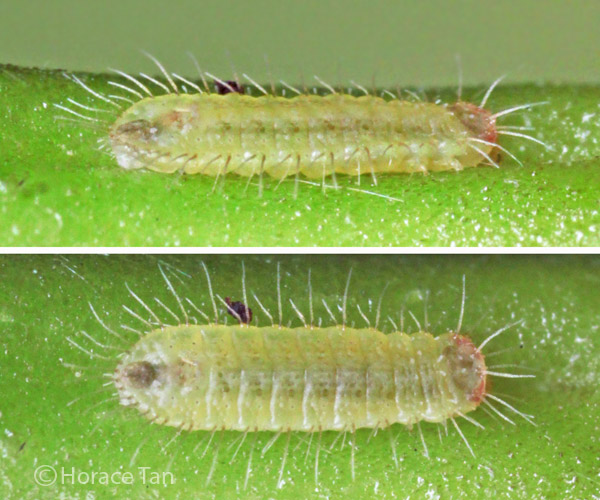
The 1st instar caterpillar feeds on surface of a young leaf leaving small holes on the leaf lamina. A  few caterpillars have been observed in the field sharing a feeding site with no animosity towards each other. Towards the end of 1st instar, pinky red patches appear on the front portion of the prothorax and the posterior abdominal segments. After 2 days of growth and reaching a length of about 2.2-2.5mm, the caterpillar moults to the next instar.

Two views of a 1st instar caterpillar, length: 2.1mm.

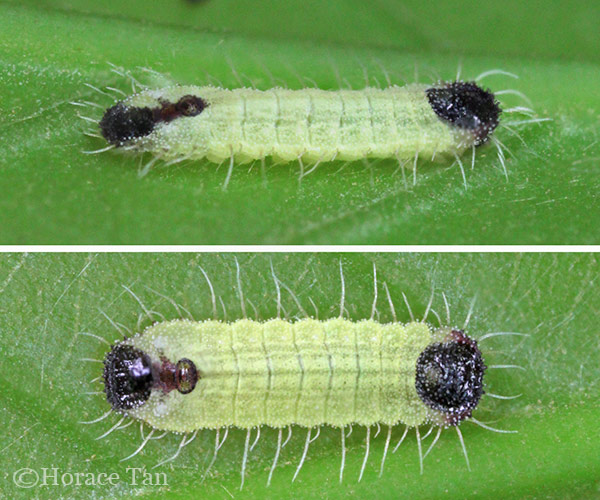
The 2nd instar caterpillar features long lateral setae and a black head. Long dorso-lateral setae are no longer present, but many short setae appear on the entire body surface. The prothorax is marked by a large black patch with a leading edge in pinky red. The dorsal nectary organ (DNO), ringed in dark reddish brown,  is already visible on the 7th abdominal segment.  It is flanked on its upper edge by a  small dark reddish patch, and on its lower edge, a much larger one which covers the dorsum of the 8th abdominal segment. The pair of tentacular organs on the 8th abdominal segments are also present. A large black anal plate dominates the remaining posterior segments. This instar lasts for 3-4 days with the body length reaching about 4mm before the moult to the 3rd instar.

A newly moulted 2nd instar caterpillar of the Darky Plushblue.

Two views of a 2nd instar caterpillar,  length: 3.3mm.

The 3rd instar caterpillar resembles the 2nd instar caterpillar closely with a few changes.  The DNO is now prominently marked with a  dark brown oval ring. The red dorsal patch on the 8th abdominal segment has two lateral arms, though faint in appearance, reaching up to the tentacular organs. The 3rd instar takes about 3-4 days to complete with the body length reaching about 7-7.5mm.

Two views of a 3rd instar caterpillar, early in this stage, length: 4mm.

Two views of a 3rd instar caterpillar, late in this stage, length: 7.5mm.

Ants attending to a pair of Darky Plushblue caterpillars on L. elegans.

Ants attending to a  Darky Plushblue caterpillar on L. conocarpus.

The 4th instar caterpillar has similar markings as the 3rd instar caterpillar. One notable change is in the prothoracic dark patch which now has two small and diffuse white markings embedded near its posterior edge. Another change is in the red side arms on the 8th abdominal segment, being broader and more prominent. The dorsal band becomes darker and prominent in this instar too. The 4th instar takes about 5-6 days to complete with the body length reaching about 12-12.5mm.

A 4th instar caterpillar of the Darky Plushblue, newly moulted, length: 7mm.

Two views of a 4th instar caterpillar, late in this stage, length: 10mm.
Two views of a  4th intar catepillar, dormant prior to the moult to the next instar, length: 12mm.

Ants attending to Darky Plushblue caterpillars.

Compared to the 4th instar, the 5th instar caterpillar has similar but more striking markings. Visible changes are  0) The two embedded white patches in the prothoracic patch are now distinctly marked; 1) The  dark prothorax patch is  flanked in white  on both  sides giving it a hour-glass shape; 2) The black anal plate is also flanked in white on both sides; 3) The two tentacular organs are ringed in black. Towards the last 1-2 days of this instar, the base colour of body turns  from yellowish green to milky white.

Two views of a 5th intar caterpillar, early in this stage, length: 14.5mm.

Two views of a  5th intar caterpillar, late in this stage, legnth: 20.5mm.

After 6-8 days of feeding and reaching a length of about 19mm, the caterpillar stops feeding during the final day of the 5th instar. During this time, its body gradually shortens and the longitudinal bands on its body disappear. Soon the caterpillar becomes an immobile pre-pupa confined to  its leaf shelter. The pre-pupal caterpillar prepares for pupation by spinning a silk girdle and a silk pad to which it attaches via graspers at its posterior segment.

Two views of a pre-pupa of the Darky Plushblue.

Pupation takes place after a 1-day pre-pupal period. The pupa, with a length of 12-14mm, has a shape typical of a Lycaenid species. Its body is whitish with a yellow tinge,  and with  spiracles marked in a contrasting orange coloration.

Two views of a pupa of the Darky Plushblue, length:12mm.

7 days later, the pupa turns dark in its wing pads, the thorax and the dorsum of its abdomen.  Shining blue patches on the forewing upperside can now be seen in the wing pads with the extent of its coverage revealing the gender of the pupa. The next morning, the pupal stage comes to an end with the emergence of the adult butterfly.

Two  mature pupae of the Darky Plushblue. Top: female; Bottom: male.

A newly eclosed Darky Plushblue waiting for its wings to be fully firmed up before taking its maiden flight.

References:
  • The Butterflies of The Malay Peninsula, A.S. Corbet and H.M. Pendlebury, 4th Edition, The Malayan Nature Society.
  • A Field Guide to the Butterflies of Singapore, Khew S K, Ink on Paper Comm. Pte. Ltd., 2010.
  • Butterflies of Thailand, Pisuth Ek-Amnuay, 1st Edition, 2006.
  • Notes on the life histories of a number of butterflies of the subfamily Theclinae (Lycaenidae), Morrell R.,  Malay. Nat. J. 10: 104-108, 1956.
Text by Horace Tan, Photos by Benjamin Yam, Nelson Ong, Loke PF, Federick Ho  and Horace Tan.

Butterfly of the Month - September 2012

Butterfly of the Month - September 2012
The Acacia Blue (Surendra vivarna amisena)


The month of September blows past, bringing in the colder winds of autumn in the northern hemisphere as the year 2012 move towards its final three months. As the 9-11 (Sep 11) anniversary came and went without much incidents, the month of September 2012 featured unrest again in the Islamic world, as Muslims protested rather violently against an ill-conceived film produced by an amateurish zealot in the US who definitely wasn't using his brain (if he had one).


Elsewhere nearer in Asia, disputes erupted between China and Japan over a few little uninhabited rocks in the sea - the Senkaku Islands (to the Japanese, or Diaoyu Islands, to the Chinese). The Senkaku Islands are located in the East China Sea between Japan, the People's Republic of China, and Taiwan. The archipelago contains five uninhabited islands and three barren rocks, ranging in size from 800m2 to 4.32km2.


In various cities in China, protesters damaged Japanese-owned establishments and objects of Japanese origin.  Again, a senseless display of violence and destructive nature of human beings, stirred up by nationalistic fervour and challenge to a nation's sovereignity.  One can only hope that diplomacy and common sense will prevail to end such unrest, in a turbulent world that is already unstable in the face of economic crisis.


Back in Singapore, concerns of a recession looms, as indicators show some evidence of a softening economy across many sectors.  Will Singapore be able to take another storm so quickly?  Or will it be another short-lived downturn that will pass quickly? On another pressing issue, that sparked active national "conversations" it has been estimated that Singapore's population has increased to 5.31 million, and growing. That's 7,257 persons per sq km! From the Department of Statistics' site, only 61.8% of the population are Singapore citizens, with the other 38.2% non-citizens. What should Singapore's 714 sq km carrying capacity be? The jury is still out on that.


September's Flower is usually associated with the Aster. There are roughly 180 species within the genus, all but one being confined to Eurasia. The name Aster comes from the Ancient Greek word ἀστήρ (astér), meaning "star", referring to the shape of the flower head. The Aster is unique for its delicate purple colour.  Legend has it that burning the Aster leaves will keep away snakes. In French tradition it is said that placing the flowers on the grave of a dead soldier is a tribute to his bravery.


Our feature butterfly for September is the Acacia Blue (Surendra vivarna amisena).  This small Lycaenid (wingspan about 28-32mm) is not rare. It is more often encountered in the forested areas than urban Singapore, although it is quite widespread in distribution, and occurs in parks and gardens as well.  It has a rapid flight and can be quite skittish.  Females are often encountered in the vicinity of its favourite host plant, the Albizia.  


The English common name "Acacia" suggests that the butterfly has some sort of association with the Wattles (Acacia spp.).  Indeed, upon checking up on the genus Surendra, there are related species like S. quercetorum (a species that does not occur in Singapore) does feed on species of Acacia like Acacia pennata. This could have been the rationale for the origin of the name Acacia Blue, although here in Singapore, the species has thus far not been known to be associated with any Acacia plants.


Sunbathing Acacia Blues showing off their uppersides - top female; bottom male

The male Acacia Blue is deep purple-blue above, with a thick jet-black apical border on the forewing.  The female is steely blue, and generally unmarked on both wings above.  The underside is a hair brown with small and obscure dark spots and striae on both wings.  The tornal area of the hindwing has silvery-green markings.  There is a short stubby tail at vein 2 of the hindwing and another short tooth at vein 3.


This green-eyed species' caterpillars are usually found on the host plants co-existing with a species of ants.  The well camouflaged caterpillar has been successfully bred on at least three different species of Leguminosae in Singapore.  Both sexes are observed to open their wings to sunbathe at certain hours of the day, showing off their blue uppersides.


Text by Khew SK : Photos by Sunny Chir, Chng CK, Federick Ho, Khew SK, Henry Koh, Koh CH, Loke PF, Nelson Ong, Jonathan Soong & Horace Tan


Life History of the Perak Lascar

Life History of the Perak Lascar (Pantoporia paraka paraka)


Butterfly Biodata:
Genus: Pantoporia
Hübner, 1819
Species: paraka Butler, 1879
Subspecies: paraka
Butler, 1879
Wingspan of Adult Butterfly: 35-45mm
Caterpillar Local Host Plants:
Dalbergia candenatensis (Leguminosae), Dalbergia rostrata (Leguminosae), Cnestis palala (Connaraceae).


Physical Description of Adult Butterfly:
Above, the wings are dark brown to black with orange markings. On the forewing, there is a broad orange cell streak with two small indentations.  There are two orange submarginal lines on the forewing, one or both of which bends at  space 3.  The hindwing has a subbasal streak passing through base of cell, and a basal streak passing along costa. The dorsum of the thorax has a small yellowish green band aligned with the forewing cell streaks. Underneath, the wings have pale orange markings corresponding to those on the upperside, but generally larger, more diffuse  and edged in brown to black along some edges..These markings are set against a background in a shade of yellowish orange.


Field Observations of Butterfly Behaviour:  
This species is moderately common in Singapore.  It is more frequently found in back mangrove habitats (Sungei Buloh Wetland Reserve, Kranji nature trail, Pulau Ubin and Pulau Semakau) where its host plant,  Dalbergia candenatensis, thrives. The species can also be sighted, though less frequently, along forest trails in the nature reserve where its other host plant, Dalbergia rostrata,  is growing in small clusters on trail sides. The adults are weak flyers but are rather alert and skittish, and would quickly ascend to the tree top when alarmed. The adults have been sighted visiting flowers and puddling on wet ground, and would typically open their wings fully when perching.


Early Stages:
Of the three recorded local host plants for the Perak Lascar, two are Dalbergia species which are both relatively common in back mangrove habitats and in parts of the  nature reserve respectively. The third host plant, Cnestis palala (Connaraceae) which is relatively  rare in the nature reserve,  is also utilized by the immature stages of the Burmese Lascar.  

Local host plant #1: Dalbergia candenatensis.

Local host plant #2: Dalbergia rostrata.

Local host plant #3: Cnestis palala.

The caterpillars of the Perak Lascar feed on the young to middle-aged leaves of its host plants.  They typically feed in the open on the leaf surface, and rest on the midrib between feeds. The lamina of each leaf is usually eaten from the tip, leaving the midrib uneaten. But unlike the Athyma spp., there is no attempt to construct frass chain or frass barrier.  As in the case of Lasippa spp., the caterpillar of the Perak  Lascar in all instars has the habit of cutting rachis and petiole of the leaf it resides on and using silk threads to attach pieces of cut lamina to the exposed midrib. Its diet consists mostly of the brown and withered leaf lamina created in this process.

An early instar Perak Lascar caterpillar found on a leaf of Dalbergia rostrata in the nature reserve.

An early instar Perak Lascar caterpillar found on a leaf of Dalbergia candenatensis in Kranji nature trail.

The eggs of the Perak Lascar are laid singly at the tip of a leaf  or a budding young shoot of the host plant. The ovipositing female shares a common ovipositing routine adopted by a good number of  Nymphalidae species: After landing on a leaf and finding it suitable, the female reverses along the leaf surface, typically along the midrib, until its abdomen tip reaches the leaf tip where an egg is then deposited.

A mother Perak Lascar laying an egg at the leaf tip of a young leaf of Dalbergia rostrata.

Two views of an egg laid at a leaf tip. Diameter: 0.9mm.

The eggs are somewhat globular in shape, with surface marked with hexagonal pits and bearing spines at pit corners, giving them the appearance of minute sea-urchins. The micropylar sits atop. Freshly laid eggs are green in colour, but turning yellowish with rosy red patches when maturing. Each egg has a diameter of about 0.9mm. The egg takes about  3 days to hatch. The young caterpillar emerges by eating away part of the egg shell. The rest of the egg shell becomes the first meal for the newly hatched, which has a length of about 2mm. It has a cylindrical pale greyish brown  body covered with many small tubercles and short setae. Four pairs of subdoral tubercles, found on the 2nd,  3rd thoraic segments and 2nd, 8th abdomnal segments,  are somewhat larger than the rest. The head capsule is similarly coloured but in a darker shade of brown.

Two views of a mature egg.

Two views of  a early 1st instar caterpillar, hours after it emerged from its egg., length: 2.2mm.

As the caterpillar grows, the body turns increasingly darker. The four pairs of subdorsal tubercles becomes more prominent. After reaching about 4.0mm in 2 days, the caterpillar moults to the 2nd instar.

Two views of a 1st instar caterpillar, late in this stage, length: 4mm.

The body color of the 2nd instar caterpillar is yellowish brown to reddish brown with a series of lateral oblique and inconspicuous streaks. Besides tiny tubercles covering most of its body surface, the 4 subdorsal pairs of tubercles have become longer and more spine-like with short protuberances. Furthermore, each of the two thoracic pairs of spines appear to  be connected with a slightly raised ridge between the two spines on each side. White strips are featured at the base of 8th and 9th abdominal segments. The head capsule is dark brown and dotted with a number of pale yellowish brown conical tubercles. This instar lasts about 3 days with the body length reaching about 5.5-6mm.

Two views of a 2nd instar caterpillar , length: 5.2mm.

The 3rd instar caterpillar has similar body markings as the 2nd instar  but with all  4 paris of subdorsal spines longer proportinately, and ridge connection in the two thoracic pairs more evident. A large saddle becomes apparent with a curved and tapering boundary taking shape, stretching from the base of the 2nd abdominal segment to a spot on the dorsum  of the 8th abdomnal segment between the two subdorsal spines.  This instar takes about 6-8 days to complete with body length reaching about 8-9mm.

Two views of a 3rd instar caterpillar, early in this stage, length: 6.5mm

Two views of a 3rd instar caterpillar, length: 9mm

The 4th instar caterpillar resembles the 3rd instar caterpillar closely. The oblique lateral brown streaks gain greater prominence with an increase in its shade of brown. A black lateral patch now appears  on the 6th abdominal segment, right on the boundary line of the saddle marking. The subdorsal pair of spines on the 8th abdominal segment are now the longest of all the subdoral spines, and are backward pointing as in the case for the pair on the 2nd abdominal segment.  This instar lasts about 8-9 days with the body length reaching about 12-13mm.

Two views of a newly moulted 4th instar caterpillar, length: 9.5mm.

Two views of a 4th instar caterpillar, late in this stage,dormant prior to its moult.

A 4th instar caterpillar found on its resident leaf in a back mangrove habitat.

Except from the proportionately increase in the length/size of the body and head capsule, the 5th instar caterpillar is little changed from the 4th instar in all body markings and features.


Two views of a newly moulted 5th instar caterpillar.


Two views of a 5th instar caterpillar feeding on withered leaf lamina, late in this stage, length: 17mm.

A 5th instar caterpillar found on a leaf in the field. The right panel contains a close-up view.

The duration of the 5th instar is rather variable, ranging from 10 days to 18 days in various bred specimens. The maximum body length is just as variable, with some only reach up only 17mm  and the longest ones up to 21mm.  On the last day, the color of the body decolorises slightly for some specimens, and none at all in others.  Typically, the fully grown caterpillar ceases feeding and stays dormant for a while. Then it proceeds to the tip of the midrib of a  eaten leaf, and spins a silk pad right at the tip. The caterpillar then turns around and attaches its graspers to the silk pad. From this head-up position, it  then gradually lets loose of its foot grip and in one short instant drops down to assume the hanging pre-pupatory posture. This particular `head-up drop' procedure is only adopted by a handful of Nymphalidae species.


A Perak Lascar caterpillar going through the chores of becoming a hanging pre-pupa.

Two views of a pre-pupa of the Perak Lascar.

Pupation takes place about 0.5 to a day later. The pupa suspends itself via a cremastral attachment to the silk pad at the leaf tip. It is almost entirely dark to rusty brown in color, with the ventral side of the head region and leading edge of the wing cases in a lighter shade of brown. The abdominal segments are  bent and tapering to the thin  and narrow cremaster at its posterior end. The wing cases are rather large and broaden laterally. The dorsum of the thorax is angular and is adorned with a number of silvery spots. The head is bluntly cleft at its front edge with small pointed lateral vertices. Length of pupae: 11-12mm.

Three views of a pupa of the Perak Lascar.

A pupa of the Perak Lascar found in the field.

After about 5 days of development, the pupal turns dark as the development within the pupal case comes to an end. The orange spots and streak on the forewing upperside also become discernible. The following day, the adult butterfly emerges from the pupal case.

Three views of a mature pupa. Orange markings on the forewings are now visible.


A Perak Lascar caterpillar emerges from its pupal case.


A newly eclosed Perak Lascar hanging on to its pupal case.


Another newly eclosed Perak Lascar hanging on to its pupal case.

References:

  • [C&P4] The Butterflies of The Malay Peninsula, A.S. Corbet and H.M. Pendlebury, 4th Edition, The Malayan Nature Society.
  • A Field Guide to the Butterflies of Singapore, Khew S K, Ink on Paper Comm. Pte. Ltd., 2010. 
  • Butterflies of Thailand, Pisuth EK-Amnuay, 1st Edition, 2006.
Text by Horace Tan, Photos by Benedict Tay,  Khew SK and Horace Tan