Random Gallery - Common Tiger

Random Butterfly Gallery
The Common Tiger (Danaus genutia genutia)


This is the last of a long series of butterflies seen and photographed at Gardens by the Bay. With the planting of appropriate host and nectaring plants at GB, the butterfly population has been increasing steadily, with the number of species spotted reaching about 50. It will remain to be seen in the coming weeks how the current haze from forest fires in Sumatra, Indonesia, will affect the butterfly population in Singapore. Reaching a PSI of 401 and the highest on record, the environmental impact on our fauna is something that researchers may want to document.

This Common Tiger is amongst the Danainae species that are attracted to the secretions of the Rattleweed (Crotalaria retusa). In particular, they like the seed pods of the plant, where the butterfly appears to scratch the surface of the seed pods with their sharp tarsal claws, causing a "wound" that secretes a transparent sap that the butterfly likes. In this shot, taken by ButterflyCircle member Loke PF, the Common Tiger feeds on secretions on the yellow flower and buds of the Rattleweed.


Random Gallery - Black Veined Tiger

Random Butterfly Gallery
The Black Veined Tiger (Danaus melanippis hegesippus)


Despite the haze, our butterflies still need to go about their daily activities and surviving the best they can in environmentally hazardous conditions that they can do nothing about. Given the biology of butterflies and their caterpillars, they breathe through a series of openings at the sides of their abdomens called spiracles. Oxygen is transported via a complicated structure of tubes and air sacs to the cells. Varying sizes of butterflies and caterpillars would mean that the spiracles vary in size as well. We do know that haze (or simply smoke) consists of suspended particles in air. Some of these particles are big, relative to the size of the butterfly's spiracles. It is highly possible that these particles can clog up these spiracles, and prevent the butterfly or caterpillar from breathing properly, effectively suffocating it. Picture a first instar caterpillar which measures no longer than 1-2mm.

This adult butterfly, a Black Veined Tiger, goes about its business of feeding on the flowers of the Blood Flower (Asclepias currasivica) at Gardens by the Bay. ButterflyCircle member Sunny Chir photographed it. Will our butterflies and caterpillars be severely affected by the current haze in Singapore? Like all living/breathing organisms, I am sure there is some effect. How bad this effect is, is yet to be seen in the coming weeks.

ButterflyCircle in the News!

ButterflyCircle in the News!
Shutterbugs on the Prowl


© Singapore Press Holdings - ST Life! Weekend article 14 June 2013 by Lea Wee

ButterflyCircle was featured in a media article about nature photographers in yesterday's Straits Times Life! Weekend section. The article, by ST journalist Lea Wee, spoke about nature photography in Singapore, the various interest groups and their respective subjects. ButterflyCircle's 14-year old talent, Jonathan Soong, was prominently featured on the main photograph of the article, whilst he was stalking a butterfly at our outing last Sunday at Gardens by the Bay. Jonathan is now ButterflyCircle's poster boy!


The article talks about nature photography as a challenging but rewarding pursuit by hobbyists and special interest groups, and spending their free time chasing birds, butterflies, dragonflies, spiders, other critters and even plants! Looking back at my own experience over the years, the availability of affordable digital photography technology some time in the early 2000's saw a significant leap in all genres of photography, with nature photography being one of the more popular ones.


ButterflyCircle members helping each other get an unobstructed shot of a butterfly, whilst the others wait patiently for their turn

In the days of film cameras, I recall that I had to shoot, wait for the entire roll of slide film (I usually use the ISO 100 Fujichrome Velvia, 36 exposures) to be used up, send the roll for developing, and keeping my fingers crossed, hoping that the shots turn out as expected. There was at least one occasion when the entire roll of slide film came back completely black - I had misloaded the film in the camera!


The staple film of nature photographers in the good ol' days

I can never imagine going back to the film days when it was often hit-and-miss with exposures, lighting, focus and so on. And the one of the boons of digital photography - the ability to change ISOs to suit lighting conditions. With a roll of film, you have a fixed ISO and you have to deal with it until the next roll of film. Of course, the exorbitant cost of developing a roll of slides and printing technology in those days were pretty prohibitive, and shooting at 8 frames per second was unthinkable, unless you had a magazine of film loaded onto your camera back and you also had deep pockets!


My trusty ol' first digital camera, the twist-turn Nikon Coolpix 995!  It had an "massive" 3.34Mp sensor in those days

So the digital age crept up silently on us, and during the early days, I relented, jumped on the digital bandwagon and bought myself my first digital camera - a Nikon Coolpix 995. I still remember the heated debates between the film supporters and the digicam supporters. "There is no way that digital cameras can replace film cameras". "The resolution in film will never be surpassed by any form of digital technology". Ad infinitum... I just wonder what cameras these skeptics are using today.


ST Journalist Lea Wee interviewing ButterflyCircle's oldest member, Sunny Chir

So last Sunday, ButterflyCircle arranged an outing at Gardens by the Bay. ST journalist Lea Wee and photographer Joseph Nair joined us. Our members went about their usual butterfly chasing exploits whilst Joe stalked Jonathan and Lea interviewed Brian, Jonathan, Sunny and me.


We continued to hunt for the Vagrant, which was shot by Billy and Cher Hern just a couple of days before (more about this new find in my next blog article). But the latest addition to the Singapore butterfly fauna list was nowhere to be found, and proved elusive, despite so many of ButterflyCircle members hunting for it. The species will probably turn up again when we least expect it.


Newbie Nona looking like a damsel in distress, and then shooting confidently with Sunny's expert coaching

Two members who had been in hibernation for some time joined us on this sunny morning too, and it was good to see them back in action with the regulars. The day started out with the skies threatening to open up on us, but somehow the winds changed and we were blessed with a relatively sunny day. The butterflies were up and about, and this part of Gardens by the Bay can be considered a 'butterfly garden' by any standards. Given that it is a free-ranging butterfly garden, it is ecologically and environmentally more sustainable than a caged facility.


WANTED : The butterfly murderer!  A White Collared Kingfisher

As biodiversity increases, firstly via the horticultural palette of plants, insects like butterflies and bees will follow suit, and then the higher forms of animals will appear to feed on them. Already, we spotted a 'serial murderer' in the form of a White Collared Kingfisher (Todirhamphus chloris) lurking around the area, and our members spotted it snacking on a poor butterfly.


Three Lycaenids found at Gardens by the Bay

The rarer form-chrysippus of the Plain Tiger - a male, also made a guest appearance. In Singapore, the dominant form is the white-hindwinged form-alcippoides. The form-chrysippus which has the hindwings unicolourous with the forewings, is much rarer, and sightings of this form have been few and far between. Interestingly, as we move northwards to Malaysia, and even further afield to countries like India, the orange-hindwinged form-chrysippus is the dominant (and more common) form.


A male form-chrysippus Plain Tiger - the rarer of the two forms of Plain Tiger found in Singapore

It was fun watching veteran ButterflyCircle member Sunny Chir racing after the Plain Tiger. He was very focused, as he locked his 'gun-sights' on the skittish and constantly on-the-move butterfly and determinedly tracked it for almost half and hour. It was a case of whether the butterfly or the photographer would be fatigued first. But Sunny's shot above indicated that it was the butterfly that needed refueling break first. In an earlier blog article, Sunny shares his experience and techniques in stalking and photographing butterflies.


More colourful butterflies found at Gardens by the Bay

Butterfly photography is indeed a challenging past time. There're always the difficulties of a skittish subject, finding a clean background, lighting condition, struggling with a strong breeze at times and most importantly, understanding and respecting nature and the environment around us. Fueled by the thrill of the hunt, and the satisfaction of admiring a well-executed shot on screen makes ButterflyCircle members go out on butterfly shooting outings weekend after weekend in our quest for the 'perfect shot'.


ButterflyCircle's youngest member, Brian Goh, scrutinising his camera's preview screen to see whether he nailed that 'perfect shot' or not!

Text by Khew SK : Photos by Sunny Chir, Chng CK, Goh EC, Loke PF, Billy Oh, Nelson Ong, Jonathan Soong & Ellen Tan

Special acknowledgment to Singapore Press Holdings for the ST Life! Weekend article and Lea Wee for the excellent article on Nature Photographers in Singapore.

WildSingapore! : Shutterbugs on the Prowl!  


Random Gallery - Pea Blue

Random Butterfly Gallery
The Pea Blue (Lampides boeticus)


The Pea Blue is a widespread and common butterfly, and described to be distributed from southern Europe, throughout Africa, spreading throughout the Indo-Australian region all the way to Hawaii. On hot sunny days, it is fast-flying and skittish, but stops to perch on its favourite leaves regularly. The caterpillars feed on the Rattlebox Bush (Crotalaria pallida) and Rattleweed (Crotalaria retusa) which are common plants in wastelands and secondary forest.

This pair of mating Pea Blues was shot last Sunday at Gardens by the Bay, where it is a resident species at the areas where its caterpillar host plants grow. ButterflyCircle member Mark Wong took the opportunity to shoot this pair perched on a leaf whilst they were indisposed.


Random Gallery - Blue Pansy

Random Butterfly Gallery
The Blue Pansy (Junonia orithya wallacei)


This week, we continue to feature butterflies shot at Gardens by the Bay (GB). There was apparently a blog that commented that there were few or no butterflies at Gardens by the Bay. I wonder where the author was making his observations at. Perhaps inside the airconditioned conservatories?

ButterflyCircle member Loke PF shot this pristine male Blue Pansy on Sunday at GB. Did you know that the local subspecies of the Blue Pansy in Malaysia and Singapore was so named in honour of Alfred Russell Wallace? The Blue Pansy is a pretty but often skittish sun-loving species that prefers open grassy fields. Often males are seen dogfighting and chasing each other, sometimes in spiralling duels reaching 10-15 m up into the air.


Life History of the Grass Demon

Life History of the Grass Demon (Udaspes folus)


Butterfly Biodata:
Genus: Udaspes Moore, 1881
Species: folus Cramer, 1775
Wingspan of Adult Butterfly: 37-45mm
Caterpillar Local Host Plants: Cheilocostus speciosus (Costaceae, common name: Cane Reed, Spiral Flag, White Costus), Costus lucanusianus (Costaceae, common name: African Spiral Flag), Hedychium coronarium  (Zingiberaceae, common name: White Ginger Lily, Butterfly Ginger), Zingiber officinale (Zingiberaceae, common name: Ginger), Curcuma longa (Zingiberaceae, common name: Tumeric).


Physical Description of Adult Butterfly:
Above, the wings are dark brown. The forewing has large white hyaline spots in spaces 1b, 2 and the distal end of the cell. Smaller white spots are found conjoined in spaces 3 and 4, singly in space 5, and conjoined in spaces 6 to 9. The hindwing has a large white discal patch with irregular outline. Underneath, the wings are reddish brown. In the hindwing, the tornal area is paler brown with the large white discal patch extended to wing base. A large irregularly shaped dark brown spot occurs in spaces 1b and 2. The antenna has a whitish band just below the club.


Field Observations of Butterfly Behaviour:
Grass Demon is moderately common in Singapore. The adults are typically found in parks, park connectors and gardens where one of its many host plants in the Zingiberaceae and Costaceae families are cultivated. The adults are fast fliers among the ground cover and shrubbery. They have been observed to visit flowers for nectar, and perch on sun-bathing spots with open wings.


Early Stages:
The early stages of Grass Demon are polyphagous with its host plants mainly belonging to the Zingiberaceae and Costaceae families. The caterpillars feed on the leaves of the host plants, and live in leaf shelters constructed by cutting and folding and securing leaf fragments with silk threads.

Leaf shelters for 1st and 2nd instar caterpillars.

Local host plant #1: Cheilocostus speciosus (White Costus).

Local host plant #2: Hedychium coronarium (White Ginger Lily).

The eggs of the Grass Demon are laid singly on the upper surface of a leaf of the host plant. The hemispherical egg is wine-red mottled with milky white patches. It has a base diameter of about 1.4mm.

Two views of an egg of the Grass Demon.

Two views of a mature egg, with the caterpillar's head visible through the hole in the shell in the right view.

The egg takes about 3-4 days to hatch. The newly hatched has a length of about 2.5mm and has a black head capsule and a yellowish orange body. A few relatively long setae adorns the posterior end. A black collar mark is present in the prothoracic segment.

The dorsal view of a newly hatched caterpillar of the Grass Demon eating its egg shell, length: 2.5mm.

After hatching, the young caterpillar eats the empty egg shell for its first meal, and then moves on to construct its first leaf shelter, typically at the leaf tip. From the shelter, it then ventures out to eat the nearby leaf lamina for subsequent meals. The body takes on a green undertone as a result. The growth in this first instar is moderately paced and the body length reaches about 6.2mm in about 2-3 days before the moult to the 2nd instar.

Two view of a 1st instar caterpillar, late in this stage, length 6.2mm.

A late 1st Instar caterpillar, dormant before its moult.

The 2nd instar caterpillar is yellowish green in body colour. The head capsule is still black, but the black collar mark on the prothorax is now absent. At the posterior end, the relatively longer setae are longer present, and the anal plate is now marked in greyish brown This instar lasts about 2-3 days with the body length reaching 9.5-10.5mm.

Two view of a 2nd instar caterpillar, early in this stage, length 7.4mm.

Two view of a 2nd instar caterpillar, late in this stage, length 9mm.

A late 2nd instar caterpillar, dormant prior to its moult.

The 3rd instar caterpillar resembles the 2nd instar caterpillar closely. The anal plate is darker and almost entirely black. A whitish patch encircles each of the two spiracles on the 8th abdominal segment. This instar takes about 3 days to complete with body length reaching about 19-29mm.

Two view of a 3rd instar caterpillar, early in this stage, length 9mm.

Two view of a 3rd instar caterpillar, length 15mm.

A late 3rd instar caterpillar, dormant prior to its moult.

A Leaf shelter for 3rd and 4th instar caterpillars.

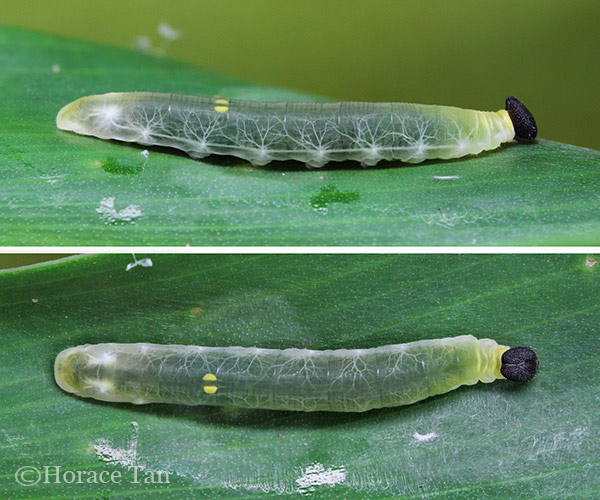
The only obvious change seen in the 4th instar caterpillar is in the anal plate which has become entirely black and much more prominent than in the earlier instars. This instar takes about 4 days to complete with body length reaching about 29-30mm.

Two view of a 4th instar caterpillar, early in this stage, length 20mm.

Two view of a 4th instar caterpillar, late in this stage, length 29mm.

A late 4th instar caterpillar, dormant prior to its moult.

The 5th and final instar caterpillar loses the prominent black marking on the anal plate seen in the 4th instar. The anal plate is now in yellowish green, the body base colour. The 5th instar lasts for about 6 days, and the body length reaches up to 40-43mm.

Two view of a 5th instar caterpillar, early in this stage, length 30mm.

Two view of a 5th instar caterpillar, late in this stage, length 39mm.

A Leaf shelter for a 5th instar caterpillar.

Two views of a 5th instar caterpillar, late in this stage with colour change taken place, length: 40mm.

On the last day of the 5th instar, the body of the caterpillar shortens and changes to a milky shade of yellowish green. It ceases feeding and comes to a halt on the under surface of a leaf of the host plant. Here the caterpillar spins a short transverse silk band and a silk girdle. At the same time, a moderate amount of white waxy substance is secreted by the caterpillar and spread over the pupation site. With its posterior end secured to the silk band via claspers and the body secured at the mid-section with the girdle, the caterpillar enters its immobile pre-pupatory stage.

A pre-pupatory larva of the Grass Demon.

Pupation takes place about 1 day later. The yellowish green pupa secures itself with the same silk girdle as in the pre-pupal stage, but with the cremaster replacing claspers in attaching the posterior end to the transverse silk band. The long and slender pupa has a long rostrum and is unmarked. Length of pupae: 37-38mm..

Two views of a pupa of the Grass Demon.

Two views of a mature pupa of the Grass Demon.

After about 7 days of development, the pupa turns black as is skin turns translucent with the development within the pupal case coming to an end. The dark forewing upperside with its white markings are now discernible in the wing case. The following day, the adult butterfly emerges from the pupal case.

A newly eclosed Grass Demon clinging onto its empty pupal case.

References:
  • [C&P4] The Butterflies of The Malay Peninsula, A.S. Corbet and H.M. Pendlebury, 4th Edition, Malayan Nature Society.
  • Butterflies of Thailand, Pisuth Ek-Amnuay, 2nd Edition, 2012
  • A Field Guide to the Butterflies of Singapore, Khew S.K., Ink On Paper Communications, 2010.

Text by Horace Tan, Photos by Benedict Tay, LC Goh, Loke PF, Anthony Wong and Horace Tan